THE THREE STACKS
Synthetic captures. Resistance opposes capture. Sovereign carries the function.
These are three modes of organizing the actual functions of human life. They are not three tribes, political identities, technology brands, historical periods, or judgments about the moral worth of every person who participates in a system.
The framework exists to identify who carries a necessary function, where authority originates, what can be controlled or withheld, what capacity really exists, and whether an arrangement has escaped illegitimate rule rather than merely changing its appearance.
Why “Stack”?
Civilization is carried through people, property, money, technology, protocols, law, enterprises, infrastructure, institutions, relationships, and habits. A stack is the operational substrate through which these arrangements carry life: how people save, communicate, produce, trade, learn, care, adjudicate, repair, govern, and preserve continuity.
A stack is not merely a software architecture or a fixed organizational hierarchy. The same life-support function may be carried through very different institutions and technical systems. The question is the governing relation, not the logo on the interface.
Two civilizational attractors; three diagnostic modes.
The Synthetic and Sovereign poles represent incompatible relationships between human functions and authority. Resistance names a crucial condition between them: a project is fighting or bypassing the captured arrangement, but its positive function remains organized around the incumbent or cannot yet be carried independently. In that limited sense Resistance can remain inside the Synthetic field even when its participants are courageous opponents of captured power. This is functional dependence, not an accusation that dissidents are secretly managed by their enemy.
Resistance is not a compulsory stage; a functioning sovereign alternative can be built directly. And a sovereign carrier may legitimately resist aggression while continuing its positive work. The distinction is whether the function would retain its purpose, economics, competent operators, and continuity if the opponent vanished.
I. THE UNIT OF ANALYSIS
Node × Function × Actual Arrangement × Defined Conditions.
Identify the node. We use five broad layers: individual, household, merchant / enterprise, local cell / community, and federation / supra-local network. Five is a practical way to organize the analysis, not a claim that civilization contains only five kinds of organization. A clinic, workshop, school, guild, cooperative, or professional association fits within these layers according to the function it carries and the scale at which it operates. These are not compulsory stages.
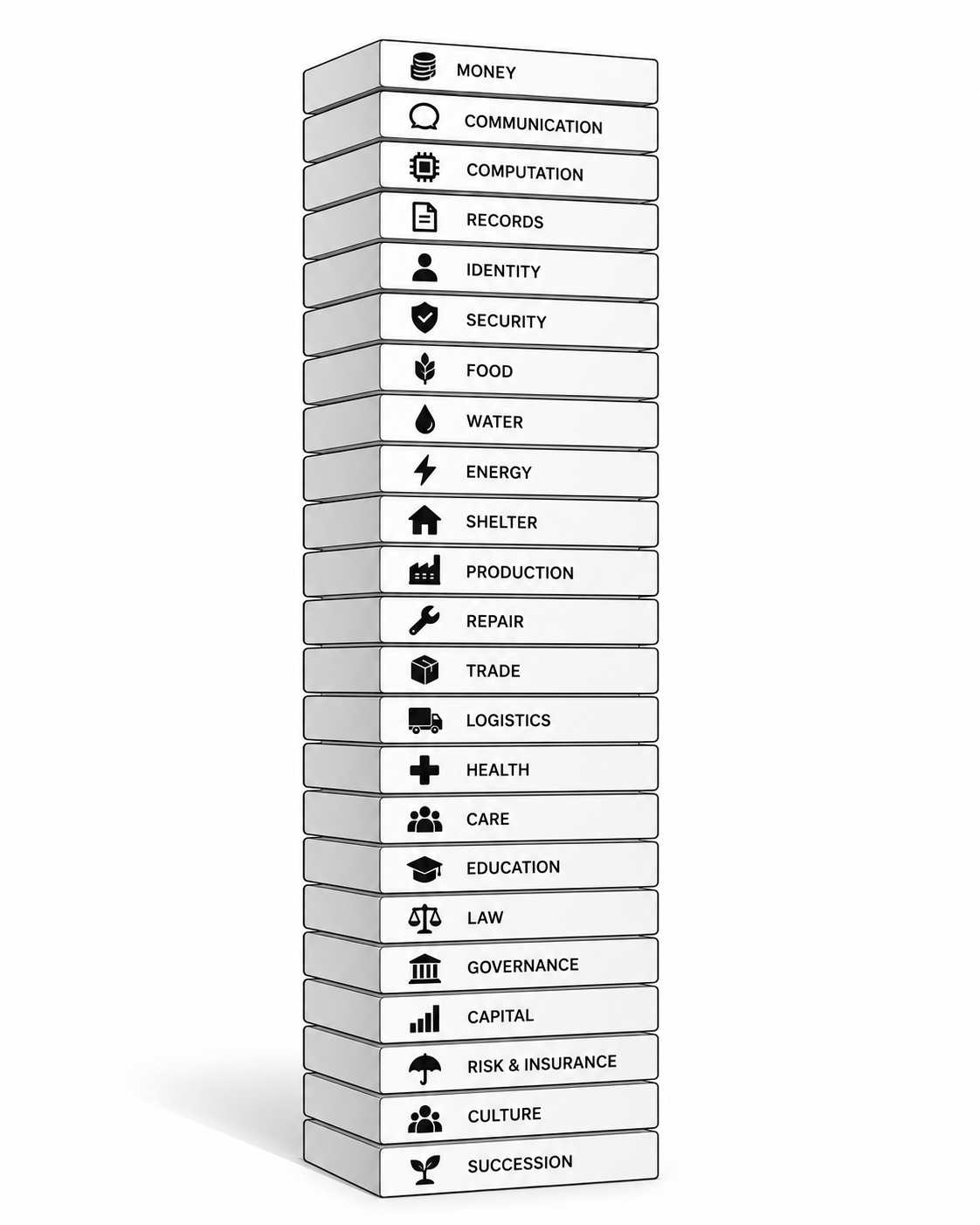
Identify the function. What recurring part of life is being carried—money, communication, computation, food, water, energy, shelter, production, logistics, health, care, education, law, records, governance, or security? Within money, for example, custody and payments may need separate examination when they involve different operators, powers, or risks.
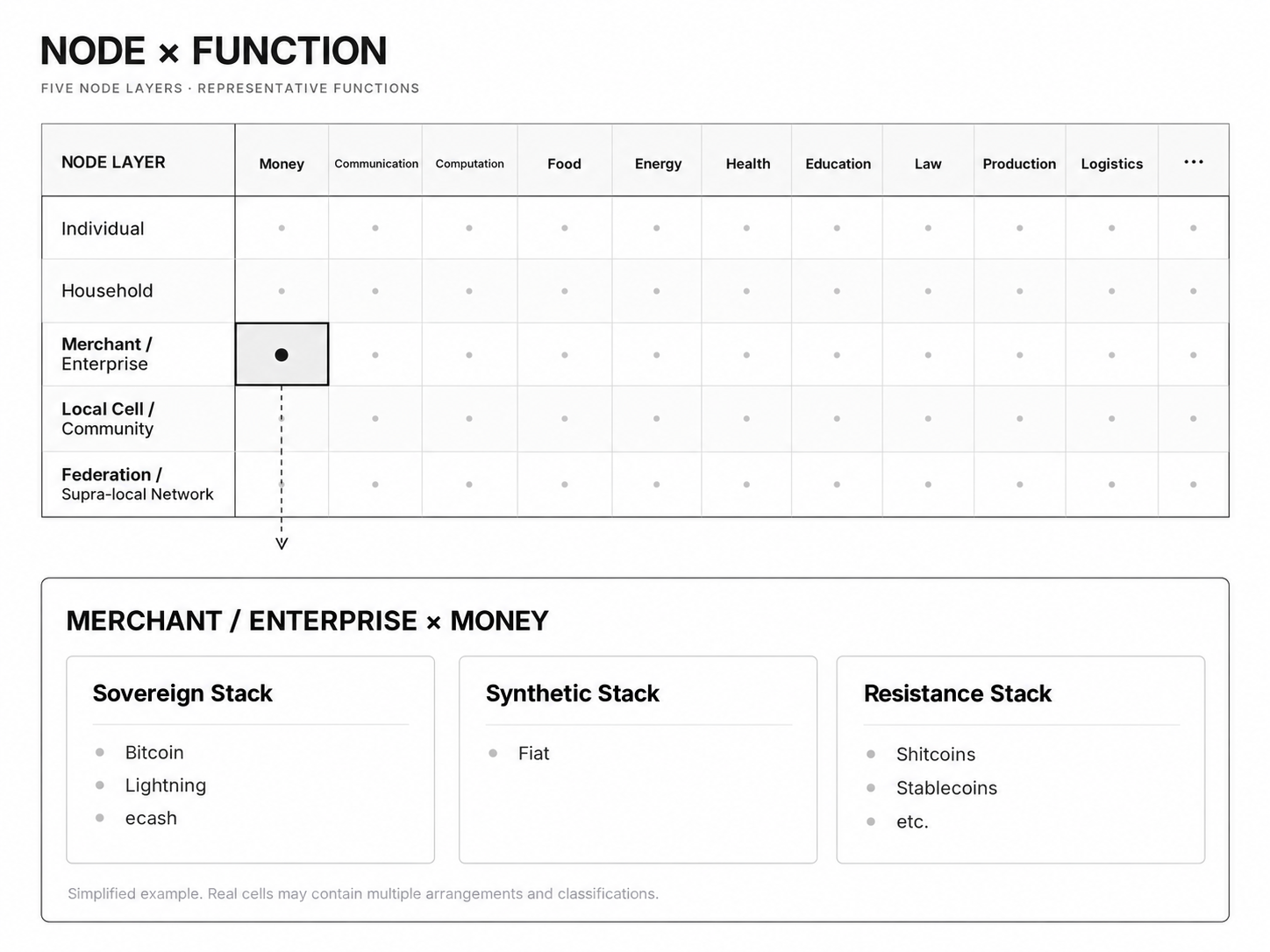
Then examine the real arrangement carrying that function under the relevant conditions: the institution, property, technology, contracts, operators, and powers actually involved.
The result may be a Stack Mode: Synthetic, Resistance, or Sovereign. It is not a final score for an entire individual, institution, nation, protocol, or culture. If several functions have different authority structures, assess them separately.
A merchant might maintain directly controlled Bitcoin savings, rely on a payment service with disputed administrative powers, hold independently recoverable records, and use ordinary competitive suppliers. Calling the entire business either Synthetic or Sovereign conceals these differences.
II. SYNTHETIC
Captured authority governing a human function.
An arrangement is Synthetic when power materially exceeds its legitimate source or domain. An intermediary can begin by solving a real problem, then use its position over the function to impose unrelated obligations, acquire unauthorized control, exploit political privilege, obscure effective ownership, or make essential participation conditional upon permissions it has no right to demand.
Capture may involve coercion, fraud, confiscation, compelled identification, politically protected exclusion, forced custody, surveillance, remote administration, platform enclosure, monetary privilege, or jurisdictional powers laundered through another function. Each accusation requires its specific mechanism; the list does not prove any particular case.
The function becomes a lever over the person. That is the inversion. The institution supposedly carrying the function increasingly makes the person serve the institution's power.
Successful mediation is often part of the causal path: a service becomes useful, reliance deepens, information and switching leverage accumulate, and the provider may gain the practical means to control more than it legitimately owns. Yet successful growth is not itself a rights violation. Capture begins where actual power or conduct exceeds rightful limits.
Read the full Synthetic Stack diagnosis →
III. RESISTANCE
Opposition to capture without completed autonomous replacement.
Resistance recognizes or challenges the captured arrangement and can produce valuable defensive or transitional capability. It may involve criticism, dissident publication, privacy tools, boycott, defensive technologies, alternative payments, independent trade, or partial exit.
Resistance is not inherently futile, fraudulent, or morally equivalent to the power being resisted. It may protect people, expose wrongdoing, create technical breakthroughs, and buy time. Some components used within a Resistance arrangement may already be Sovereign.
The Resistance Stack arises when opposition remains the organizing condition of the function itself: the opponent continues to determine what the system discusses, funds, fears, builds, or counts as success. There may be a functioning workaround, but not yet a durable capacity that can carry the function on its own terms.
Resistance fights the cage. Sovereignty constructs the exit.
There is no mandatory historical sequence in which every function must pass through Resistance. Some sovereign capabilities can be constructed directly. A genuinely Sovereign institution can also resist aggression while remaining organized around a positive function.
IV. SOVEREIGN
Rightful authority joined to actual operating capacity.
A function is Sovereign when it is carried by a real, functioning arrangement whose consequential powers possess legitimate sources and remain within their proper domains, while the relevant person or voluntary unit retains rightful agency and responsibility.
The arrangement may involve strong firms, centralized operators, specialist professionals, hierarchy, capital-intensive infrastructure, long-term contracts, private institutions, and complex supply chains. Such institutions are not automatically the enemy of sovereignty. Advanced civilization requires competence, coordination, and division of labor.
Sovereignty is not the absence of dependence. It is sovereign interdependence: specialization without subordination, connection without absorption, authority without an unearned claim to rule unrelated parts of life.
A sovereign arrangement still may be immature, economically weak, operationally fragile, poorly documented, or difficult to recover after failure. These are serious limitations. They must be recorded without pretending that fragility by itself proves captured authority.
V. WHAT MUST NOT BE CONFUSED
Centralization is not synonymous with capture. A legitimately owned hospital, factory, or professional firm may require coherent internal command. A nominally decentralized service may hide one administrator, one indispensable root, or one practical gatekeeper.
Dependence is not synonymous with domination. A surgeon depends on suppliers; a manufacturer depends on specialized equipment; a household depends on other people's knowledge. Such relationships can be legitimate. The analysis must identify what power the dependence actually confers and whether that power is exercised within rightful boundaries.
Recognition is not identical to truth. Signatures can prove defined aspects of authorship or integrity. Credentials can supply evidence of competence. Neither automatically proves the substantive claim, the completeness of the record, or the legitimacy of a resulting obligation.
Market influence is not automatically coercion. Popularity, wealth, a strong network position, voluntary refusal to trade, and large market share do not become rights violations solely because their consequences are significant. Fraud, unlawful coercion, breach, political privilege, and unauthorized jurisdiction require separate examination.
Stack Mode is not maturity, fragility, evidence strength, or future recapture risk. Record those dimensions separately. A mature captured system can perform brilliantly; an immature Sovereign alternative can fail badly.
VI. SOVEREIGN ARRANGEMENTS AND THE SOVEREIGN STACK
Calling one arrangement Sovereign means that the function in question is actually carried through legitimate authority and competent operation. It does not mean that one company, household, clinic, or protocol embodies an entire civilization.
The Sovereign Stack is the particular civilization SSDC is committed to helping develop. Its foundations include natural rights, property, voluntary order, Austrian economics, agorist construction, Bitcoin-rooted money, Nostr-based communication, libre computing, open hardware, cypherpunk privacy, productive institutions, and human flourishing. These commitments have distinct roles; one cannot compensate for violating another person’s rights merely by using favored technology.
For example, an independent medical practice can exercise rightful authority and provide competent care while using proprietary equipment. That does not make it Synthetic, nor does it mean the practice fulfills SSDC’s entire technological direction. Conversely, a Bitcoin-branded institution that defrauds its customers is Synthetic in the arrangement where the fraud occurs, whatever its monetary allegiance.
We must distinguish what is rightful, what belongs to our chosen civilizational architecture, and what has actually been built and proven to work.
VII. FROM NODE TO CIVILIZATION
Individual sovereignty does not mean that every person should be self-sufficient. A household cannot manufacture every machine, perform every medical procedure, insure every major loss, or maintain every piece of infrastructure it needs. An advanced civilization requires capable firms, specialists, capital, trade, institutions, and a deep division of labor.
The five node layers help show where different responsibilities are carried. A function belongs at a scale capable of performing it well, under rightful authority and with the people and resources it actually requires. Sometimes that means an individual or household. Sometimes it means a large enterprise, specialized professional institution, or supra-local network. Neither smallness nor decentralization is a substitute for competence.
Capable nodes also need to connect. Enterprises require customers and suppliers. Households need services and opportunities to trade. Physicians need laboratories and equipment. Producers need finance, transport, and markets. Such cooperation can be organized through strong, independently governed institutions without requiring one institution to command the entire network.
Those connections create new questions about power. A payment provider, insurer, accreditor, registry, or marketplace may legitimately govern the service it supplies. That authority does not automatically extend to unrelated property, identity, employment, beliefs, or commercial relationships. The danger is not interdependence itself, but allowing control over one necessary function to become unauthorized rule over others.
Finally, sovereign institutions must be capable of creating further capacity: firms that reinvest, experienced operators who train successors, productive relationships that open new markets, and institutions that can survive their founders. A functioning civilization is more than a collection of independent tools or isolated projects. It is an expanding order of productive people and institutions, connected through rightful cooperation and able to carry life forward.
The Sovereign civilization →The Synthetic diagnosis →The development work →