ROADMAP
From the first operating projects to a civilization capable of building more of itself.
SSDC is being built for a generational undertaking. Its first objective is considerably more concrete: help bring a missing sovereign capability into real operation, then develop the competence to do it again.
The first year has a defined campaign. What follows is a longer development direction, shaped by what the institution and the wider Sovereign Stack actually achieve.
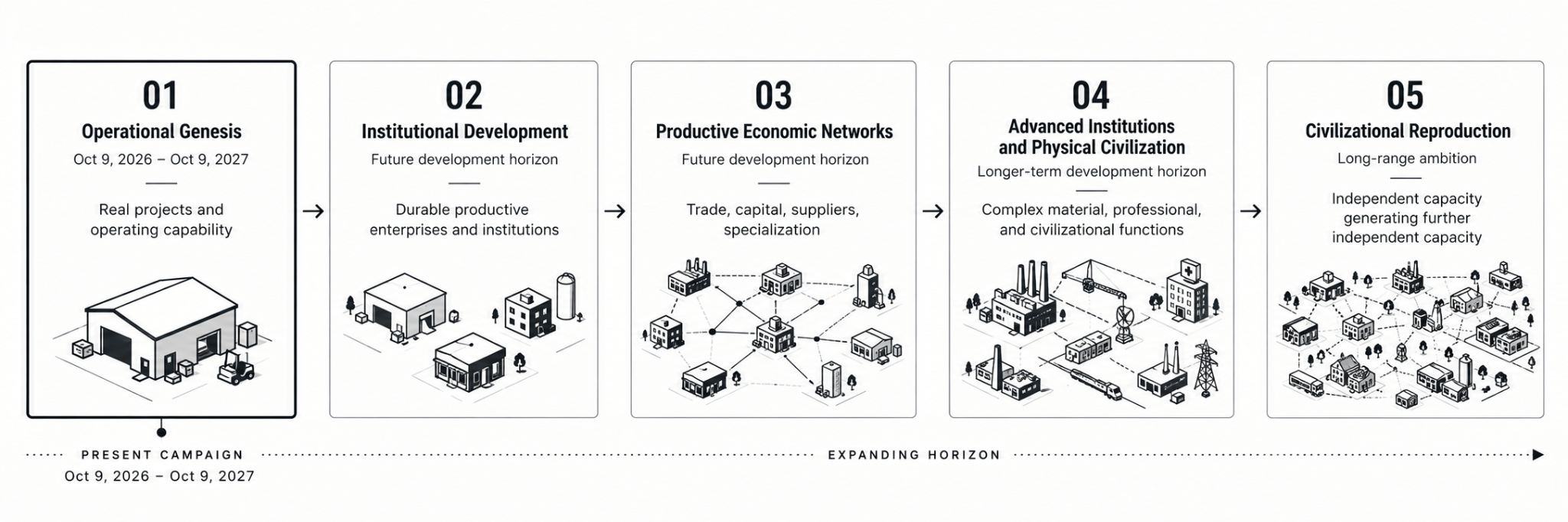
01 — OPERATIONAL GENESIS
October 9, 2026 – October 9, 2027
The opening campaign moves SSDC's research and institutional architecture into direct work with people already building the Sovereign Stack. We intend to undertake a small number of defined engagements, identify real constraints, and help create operating capacity beyond the pages of this website.
The early work may involve adapting an existing system, strengthening an enterprise, connecting producers and customers, developing missing technical or institutional capacity, or assembling the specialists required for a more difficult project. The opportunity follows what the field actually needs.
The four phases
- Enter the field — October 2026 to January 2027. Establish working relationships with existing builders and institutions. Identify the first consequential constraints and undertake a bounded engagement.
- Execute and repeat — January to May 2027. Bring a defined solution into operation, test what it accomplishes, and begin turning successful work into capability that other competent operators can carry.
- Concentrate on what matters — May to August 2027. Build on the strongest demonstrated opportunities. Develop productive relationships across existing enterprises, and pursue a new institution only where it fills a real unmet need.
- Establish continuity — August to October 2027. Strengthen what has begun to work, establish continuing responsibility, and determine the next campaign from demonstrated results.
These windows are planning horizons, not claims that the intended outcomes have already occurred.
What would count as progress?
- Real-world work: an actual institution or enterprise faces a demonstrated constraint and SSDC contributes something substantive to overcoming it.
- Operating results: a useful capability functions in practice, with identified people responsible for carrying and maintaining it.
- Economic footing: the costs, customers, capital, risks, and continuing obligations can be borne by a viable arrangement.
- Independent continuity: the work can survive beyond a single intervention and contribute to SSDC's ability to undertake more difficult projects.
02 — INSTITUTIONAL DEVELOPMENT
From useful projects to durable institutions.
Repeated work will reveal opportunities that cannot be resolved by a one-time deployment. A missing capability may require a new specialist enterprise, a productive facility, a financing arrangement, a professional practice, or infrastructure with an operator responsible for its continued existence.
SSDC intends to develop the ability to assemble entrepreneurs, domain experts, property, capital, equipment, and customers around those opportunities. Some institutions may be owned or operated by SSDC; others will be partnerships, independent businesses, or capabilities strengthened inside existing organizations. Their form follows the work they actually carry.
03 — PRODUCTIVE ECONOMIC NETWORKS
From independent capacity to deeper specialization.
Capable institutions become more valuable when they can trade, specialize, finance expansion, obtain professional services, and connect to suppliers and customers. This is how separate sovereign projects can become an increasingly productive economy rather than remain isolated experiments.
For example, repair enterprises can make manufacturing more viable; reliable distribution can expand markets for independent producers; specialist training can give young firms the operators they cannot yet develop themselves. These relationships do not require one institution to own the network.
04 — ADVANCED INSTITUTIONS AND PHYSICAL CIVILIZATION
The capabilities required for a full modern life.
Advanced medicine, substantial manufacturing, finance and insurance, energy, infrastructure, law, housing, and other demanding functions require extensive capital, specialization, technical knowledge, and durable institutions. Sovereign civilization cannot be complete while treating these as permanent afterthoughts.
As the wider field gains productive depth, SSDC aims to contribute to increasingly ambitious developments in these domains—working with established experts and independent institutions, and developing new carriers where a genuine need and viable opportunity exist.
The larger ambition is not merely to duplicate today's institutional forms. New technologies, methods of production, and economic relationships may enable independent institutions that would once have been prohibitively difficult to create.
05 — CIVILIZATIONAL REPRODUCTION
A civilization capable of building more of itself.
The long-range measure of success is not how many institutions bear the SSDC name. It is a wider Sovereign Stack in which entrepreneurs can found capable enterprises, professional institutions form successors, capital finances productive work, and new institutions create the conditions for still more independent activity.
SSDC's own development capacity can contribute to that process, but the resulting civilization must be larger than any single company, founder, registry, or governing center. Its growth should become increasingly possible without SSDC's involvement.
WHERE WE ARE
In October 2026, SSDC remains founder-led, with substantial research and institutional architecture but a much smaller body of demonstrated operating capacity. The immediate task is to close that distance through real projects. The longer stages above are ambitions to develop toward, not achievements being claimed in advance.