THE WORK
Building the missing institutions of sovereign civilization.
The Sovereign Stack already contains serious technology, enterprises, skilled people, independent institutions, and productive infrastructure. But those capabilities do not automatically combine into an advanced, functioning civilization.
- Technologies need competent people to operate, secure, maintain, and improve them.
- Enterprises need capital and viable economics.
- Manufacturers need suppliers and customers.
- Markets need commercial relationships through which goods and services can actually move.
- Professional services depend on skilled practitioners, accountability, and institutions suited to the work.
- Infrastructure needs financing, construction, maintenance, and responsible operators.
SSDC works to develop the missing capacity that allows sovereign people and institutions to produce more, cooperate more effectively, and build further independent capacity.
THE DEVELOPMENT PROBLEM
Consider four independent enterprises. One has exceptional engineers but too little manufacturing capacity. Another owns productive machinery but lacks consistent demand. A third has customers but cannot secure suitable financing. A fourth can repair vital equipment but has no reliable distribution network.
Each enterprise is real. So are its assets and its competence. What is missing is the productive relationship or institution that would allow those capabilities to work together.
The solution might be:
- An equipment-financing arrangement.
- A procurement or distribution business.
- A shared professional service.
- An experienced operator.
- A new supplier or customer relationship.
- A technical integration that makes existing systems work together.
- A specialized productive enterprise.
- An institution that enables several activities at once.
Another directory or communication protocol might be helpful, but it will not automatically finance a machine, supply a replacement part, perform a professional service, or deliver an order. The missing productive relationship or capability has to become real.
Sometimes the missing piece is an enterprise; sometimes it is capital, an operator, a connection between firms, a credible risk-bearing institution, or the capacity to continue after a founder leaves. Different constraints require different solutions. They do not all require a new SSDC organization.
HOW SSDC DEVELOPS CAPACITY
We intend to work alongside the builders and institutions already carrying parts of the Sovereign Stack. Where a capable solution exists, we can use it, buy from it, connect it with customers, partner with its operators, or help finance its expansion. Where something genuinely necessary is missing, we may help develop, acquire, or establish the appropriate enterprise, system, facility, or institution.
That work can involve engineering, commercial development, applied research, capital, physical infrastructure, legal arrangements, professional expertise, and operator formation. The particular combination depends on the actual problem.
The result should be something people can operate, maintain, trade through, or build upon—not merely a report explaining what ought to exist.
THE DEVELOPMENT FIELD
SSDC's field is intentionally broad because sovereign life is not confined to one technology or industry. These are areas of possible development, not a claim that SSDC currently operates in every one of them.
Money, capital, and commerce
Bitcoin-rooted monetary systems, treasury, commercial exchange, credit, enterprise finance, investment, and risk-bearing arrangements that support a deeper productive economy—not simply more retail transactions in Bitcoin.
Technology and sovereign systems
Nostr and independent communications, privacy, cryptography, libre computation, open hardware, data and records, security, and sovereign intelligence. AI, robotics, and advanced computing expand what independent people and enterprises may be able to produce, while making control over tools, data, and delegated authority increasingly important.
Production and physical infrastructure
Manufacturing, tools, fabrication, repair, energy, water, construction, land, agriculture, transportation, logistics, and the physical systems that support modern life. Sophisticated production requires real facilities, materials, maintenance, capital, and specialized operators.
Professional and civilizational institutions
Medicine, care, insurance, private law and dispute resolution, education, applied research, and specialized professional services. These are among the hardest functions to provide well. Replacing captured arrangements cannot mean abandoning the competence, scale, or responsibility the function actually requires.
People, formation, and continuity
Entrepreneurs, craftspeople, engineers, professional specialists, operators, apprenticeships, institutional founders, leadership, succession, culture, and civilizational memory. A technology or institution that only one exceptional person can sustain has not yet become widely reproducible capacity.
Trade and cooperation between independent institutions
Suppliers, distributors, customers, professional networks, shared services, commercial credit, logistics, and the relationships through which independently owned capabilities support one another. The objective is advanced specialization without placing all participants under one compulsory institution.
THREE DEVELOPMENT HORIZONS
Escape: Remove an identifiable mechanism of coercion, confiscation, censorship, or unauthorized control over a necessary function.
Replacement: Establish a genuinely operating alternative—with the people, capital, economics, infrastructure, and institutions needed to carry that function.
Invention: Use the new monetary, technical, economic, and institutional possibilities to develop capacities that the inherited system made impractical or impossible.
The ambition extends beyond replicating existing institutions under different ownership. It includes making difficult independent enterprises and institutions easier to found, operate, and reproduce.
THE FULL FIELD AND THE NEXT BOTTLENECK
The whole civilizational field includes money, communication, medicine, law, manufacturing, care, education, energy, logistics, culture, and much else. No single development institution can build it all.
Our practical focus is narrower: what is preventing a specific capable person, enterprise, or institution from producing, trading, expanding, or continuing right now? The answer can change with prices, suppliers, technology, capital, and local circumstances. Sometimes the obstacle is wrongful control. Sometimes it is an ordinary but consequential missing capability or economic relationship.
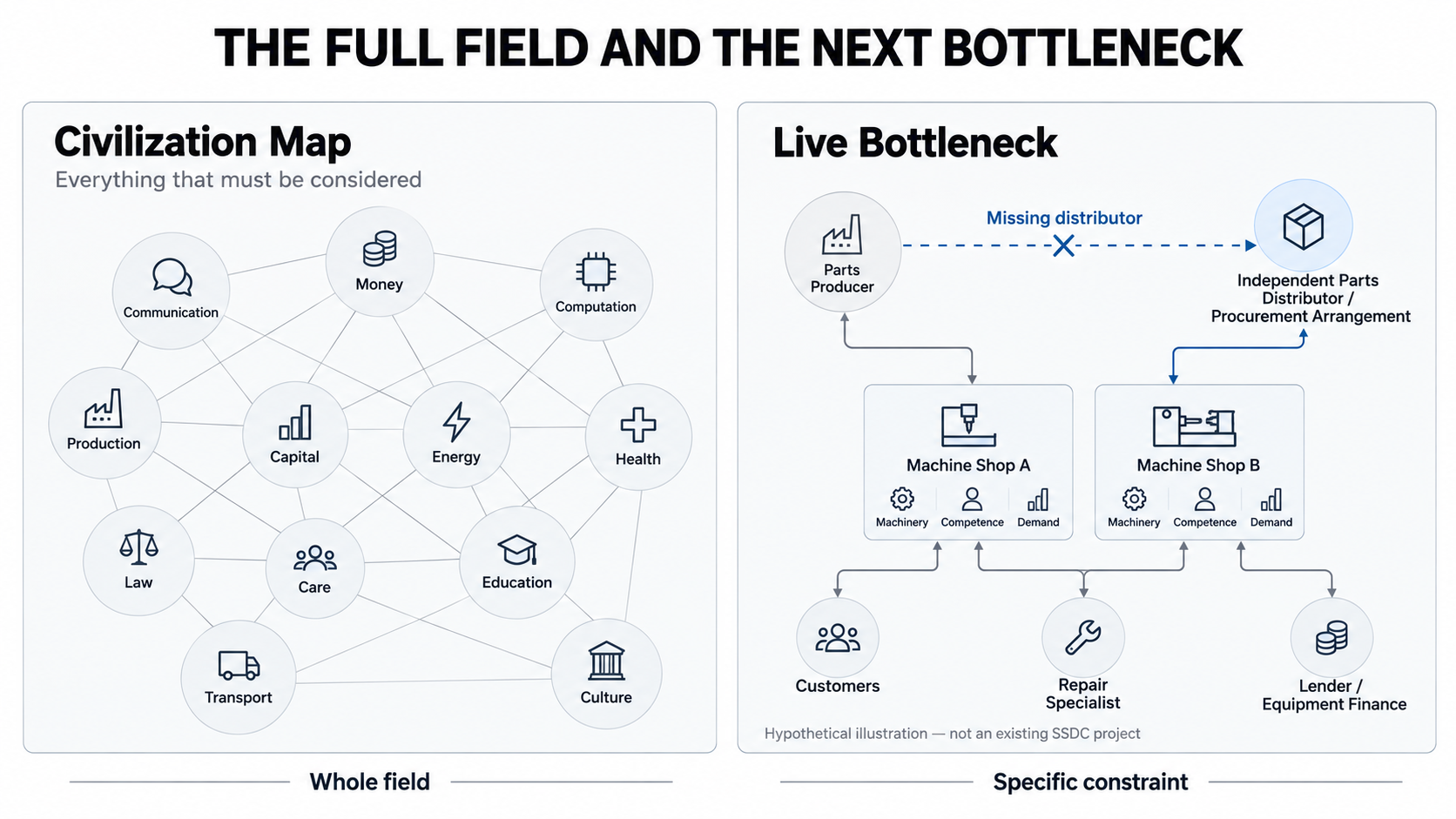
A distributor can improve the economics of several producers. Suitable insurance can make investment possible. A training institution can supply specialists to many firms. New productive relationships matter because they expand what independent actors can accomplish.
FROM ONE INTERVENTION TO CIVILIZATIONAL COMPOUNDING
A dependable repair business does more than fix equipment. It can lower downtime for manufacturers, make additional machinery worth financing, increase demand for specialists, and create a market for apprenticeships. Those operators may go on to establish businesses of their own.
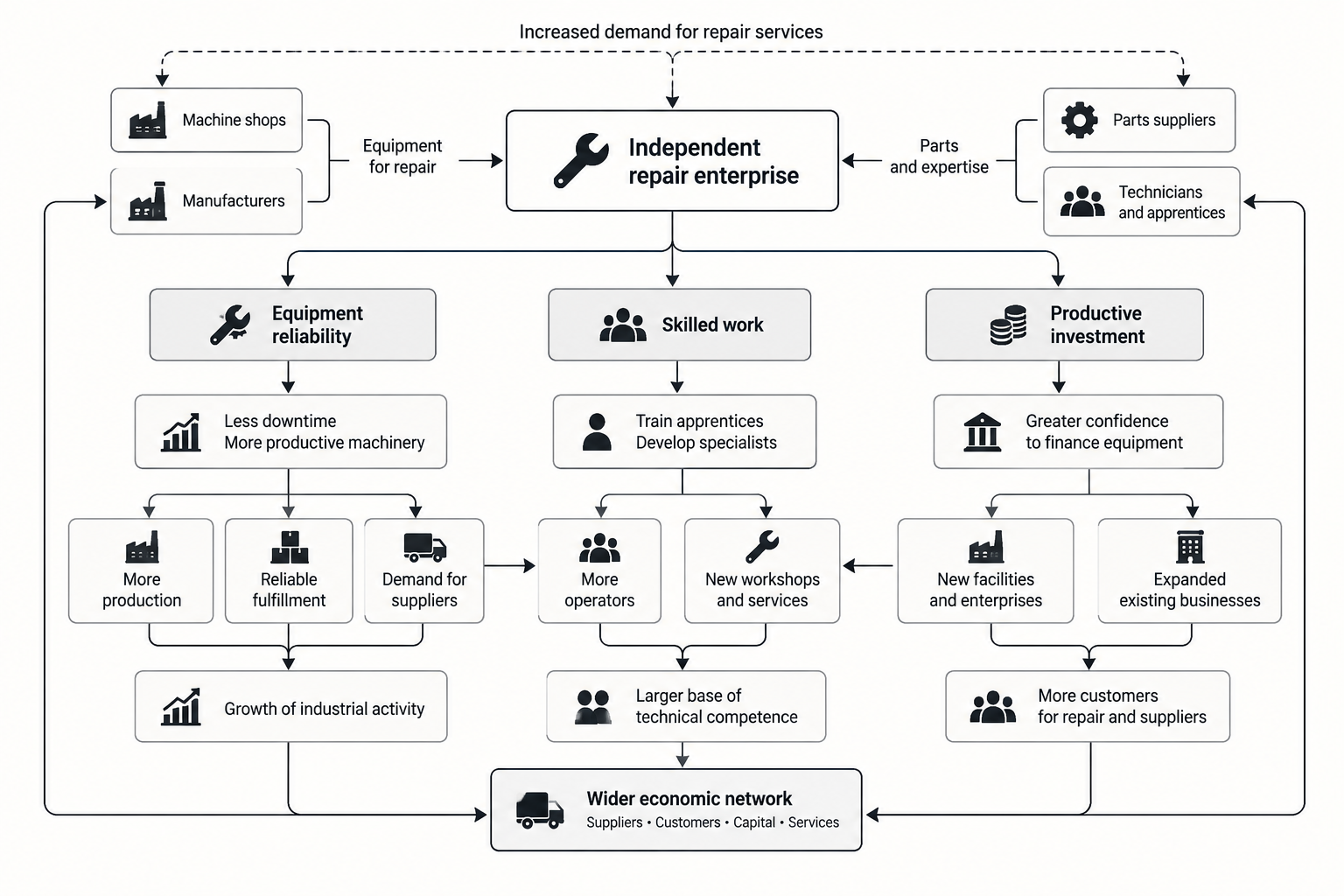
This is the larger opportunity: development that makes further independent development possible. Better productive tools, accessible specialist capacity, workable financing, transferable knowledge, and strong commercial relationships can lower the time and cost required to establish the next capable institution.
WHAT COUNTS AS REAL DEVELOPMENT
The standard is more demanding than a functioning prototype or a convincing story. The institutions and systems we help develop should be:
- Capable. They actually perform the promised function under real operating conditions.
- Rightfully governed. Property, contract, professional responsibility, privacy, and delegated powers remain within their legitimate bounds, consistent with the applicable Sovereign Stack foundations.
- Economically viable. Someone can pay for construction, operation, maintenance, replacement, and the risks the activity creates.
- Durable. Necessary knowledge, recovery arrangements, and responsibilities can survive changes in personnel, providers, and leadership.
- Genuinely additional. The result makes an identifiable capability possible or materially stronger, without claiming credit for what independent builders have already achieved.
Moving a household to self-custody is not enough if the household cannot recover or pass on its money. A productive institution that depends on one irreplaceable person may still be valuable, but its continuity remains unresolved. Nor should authority that is responsibly exercised today become unchecked power in the hands of a successor who controls tomorrow's assets, keys, records, or relationships.
These considerations shape what we intend to build and how we judge the results—not a universal checklist that declares every different arrangement illegitimate.
THE CURRENT CAMPAIGN
Operational Genesis — October 2026 to October 2027.
Our immediate campaign is to build SSDC's own capacity to carry out this kind of development repeatedly. The starting point is the existing sovereign economy: real builders, operators, enterprises, and institutions confronting real constraints.
We intend to begin with bounded field engagements, assemble the competence each one requires, establish what customers and partners actually need, and turn successful work into capabilities that can continue and expand beyond SSDC's direct involvement.
The long-term ambition is a development institution able to help create and strengthen increasingly sophisticated independent enterprises. That capacity must be earned through actual projects, not declared into existence.
BRING US A REAL CONSTRAINT
If you are building sovereign technology, operating a productive enterprise, developing physical infrastructure, creating an institution, or trying to establish a difficult economic relationship, we are interested in the constraint preventing the next step.